Architecture > Software Core
Table of Contents
Introduction
The core's objective is to manage the SI's business entities, and their read/write operations to/from a database.
Features
GraphQL API
The core makes data accessible via a GraphQL endpoint.
This endpoint responds to HTTP requests (GET or POST) sent to the server at the path <SERVER_URL>/api/graphql (for example, http://localhost:8080/api/graphql). This endpoint can be used in any GraphQL editor or from any HTTP request.
The response format is JSON.
Authentication to the server requires a specific HTTP header.
A GraphiQL editor is available at
SERVER_URL/api/graphiqlfor testing the endpoint.
Technical Implementation
Libraries and Frameworks
Here are the libraries and frameworks used by the software core's implementation:
- Database: Oracle, PostgreSQL, or HsqlDB
- Spring Boot:
- To implement the HTTP REST endpoints (GET or POST) as JEE Servlets;
- Deployable within an Apache Tomcat engine, and/or another web application using Spring Boot;
- Security management uses Spring Security to control possible access rights through authentication.
- JPA / Hibernate: for mapping between entities (Java Object) and the database;
- Apache Maven:
- For Java dependency management, compilation, and module delivery;
Software Components
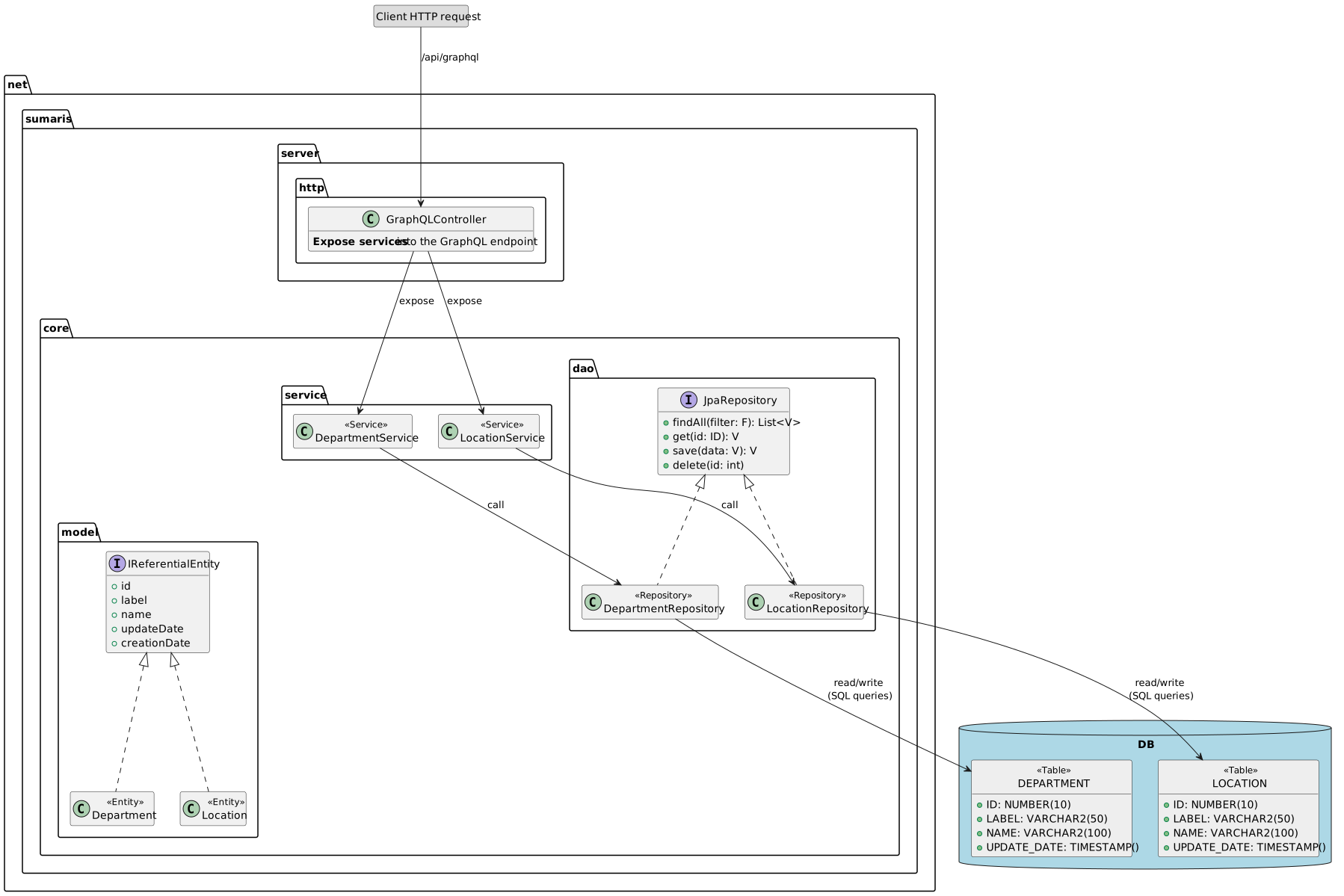
The module is divided into software components, illustrated below:
package http
The http package is responsible for responding to received HTTP requests (GET and/or POST).
The GraphQLController analyzes GraphQL requests and executes them by delegating to the requested business services. The result returned by a business service is directly converted into JSON.
package service
The service package focuses on business functions, responsible for processing read or written data. This layer also manages JDBC transactions and handles possible rollbacks in case of error.
This layer benefits from an application cache, implemented as needed to optimize data access performance.
package dao
The Repository components define the requests (Object or SQL) for accessing the database.
Each Repository is usually linked to a particular business entity.
package model
This package defines Entity which represents the underlying database model. Each Entity represents a business concept (e.g., Department represents an organism, Location a location, etc.).
The attributes of an Entity class allow configuring the columns of the associated table and its constraints (non-null, etc.)
/**
* Example of a business entity
**/
@Data
@Entity
@Table(name = "location")
public class Location implements IReferentialEntity<Integer> {

    @Id
    private Integer id;

    @Column(nullable = false, length = 50)
    @ToString.Include
    private String label;

    @Column(nullable = false, length = 100)
    private String name;

    // ...
}
package util
A util package (not shown on the software component illustration) contains utilities for manipulating various Java
object types (Stream, File, String, Date, etc.)
Security
Access rights can be managed at the level of the GraphQLController, thanks to Java annotations and Spring Security. This way, access can be limited on a case-by-case basis, for example, to allow only certain user profiles.
Configuration
Options available for configuring the core:
| Property | Description | Default Value |
|---|---|---|
server.url |
Server access URL | http://localhost:8080 |
spring.datasource.url |
Database URL (in JDBC format) | jdbc:postgresql://localhost:5432/sar |
spring.liquibase.enabled |
Activation of the database schema update by Liquibase | sar |
logging.level.org.hibernate.SQL |
SQL request logging level (set to debug to view) |
warn |